
Ian (not his real name) arrived at Ascension Chiropractic in Downtown Ottawa barely able to walk, leaning heavily on his girlfriend for support. He’d been working out at Elgin Fitness, a great local gym, and injured his back. He was in intense pain with symptoms running from his low back down his right leg. The gym owner had called ahead, knowing my experience with serious spinal and nerve injuries. It was clear from the moment Ian walked in that this wasn’t a simple back strain.
Once we got Ian settled in the exam room, I asked Ian to walk me through what happened.
He explained that he’d been putting a 70-pound dumbbell back on the lower rack. A bench was blocking his path and, rushing, he decided to lean over it instead of walking around. With weight in hand he bent forward from his waist and instantaneously felt and heard a ‘pop’ in his lower back, followed by what felt like lightning shooting through his entire body.
Pain hit instantly, radiating from his low back down the back of his right leg to his heel, along with sudden weakness that dropped him to the floor.
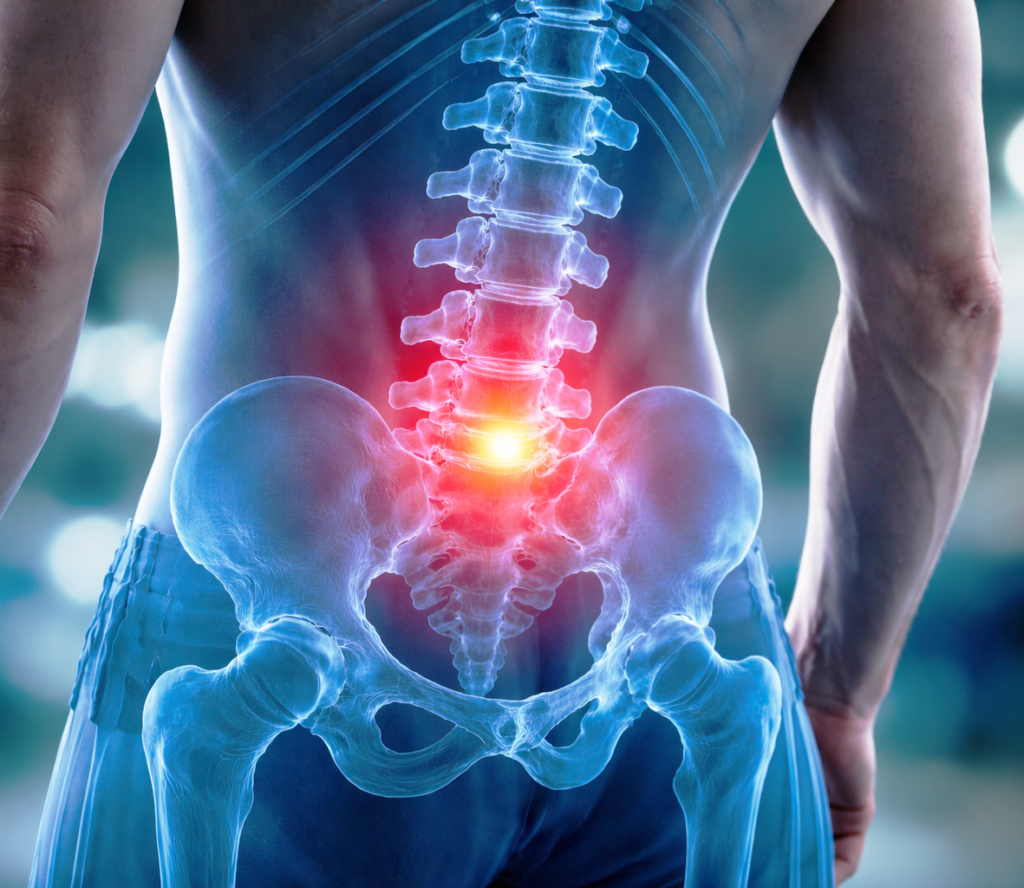
Based on his story, the exam findings, and detailed analysis of the spinal X-rays I took to fully understand any structural weaknesses and overall condition of Ian’s spine, the cause was clear: Ian had herniated his L5 disc.
So what is a herniated disc?
First of all, discs are the cushions between the bones of your spine. They’re generally quite good at absorbing forces but they have their limits. Too much ‘squishing’ pressure, especially if your posture has you bent forward and twisting, and the jelly-like substance on the inside of the disc can push outward with enough force that it stretches the stiffer fibrous outer surface layer causing it to bulge (disc bulge) like squishing a jelly donut with enough pressure to see the donut’s outer surface bulge outward. With even more pressure the jelly can push through the outer surface layer and spill outside the donut. When this happens to a disc it’s called a ‘ruptured’ or ‘herniated disc’. While this can be painful, the greatest problem occurs when the bulging or herniated disc material presses up against the spinal cord or its branches – called nerve roots. This is serious because it can block the conversational messages your brain and body are sending back and forth to each other to control the strength and healthy function of your muscles and internal organs. If this occurs in the low back, it will impact everything from your pelvis, to the tips of your toes.
Are disc bulges or hernias a medical emergency?
Rarely, but they can be. If after a low back injury you are having obvious problems controlling your bowel or bladder functions, it’s time to get to the hospital. As stated above, a herniated disc can put dangerous pressure on these delicate nerves. That pressure may need to be alleviated immediately through surgery.
Thankfully, this is rarely necessary. The vast majority of the time the disc will heal with conservative corrective care. Contrary to what many believe, surgeons don’t want to perform surgeries unless they’re absolutely necessary and the last resort. They know there are many serious risks to spine surgery that can’t be undone. Permanent!
This is why surgeons commonly recommend patients first undergo a course of conservative corrective care with a chiropractor before any surgery is considered.
So how did Ian do? Excellent!
From his X-rays and other assessments I was able to show Ian that he had some pre-existing structural and functional spine issues that had been weakening his spine and contributing to degeneration. These issues were also weakening his L5 disc.
I recommended a care plan for Ian of a series of corrective chiropractic adjustments to progressively restore the healthy function of his spine and L5 disc and then to address the overall structural problems in his spine. Through the extremely painful early phases of care, Ian found his adjustments gave him a lot of relief. He would often limp into the office literally dragging his right leg behind him and leave walking normally. It took patience but strength progressively returned to his leg as his spine function improved over the course of the first few weeks. Once the pain and weakness were gone, we focused on correcting the underlying problems to help prevent this from being an issue for Ian in the future.
Many don’t realize that small injuries and repeated stresses on the spine can silently create dysfunction in the movement and alignment of the spine leading to degenerative changes in the disc and intricate spinal joints.
Over time (months, years, decades) spinal health declines to a point when performing a routine movement suddenly brings on pain, numbness, weakness, or other symptoms and the problem becomes obvious. The good news is that chiropractors are specially trained as non-surgical experts to help you recover from a herniated disc and avoid surgery. The better news is that most of these situations can actually be avoided by keeping your spine functioning properly in the first place.
If you’re suffering from spinal issues or simply want to find out if chiropractic care could make a difference in your life and you live in the Ottawa area, please contact Ascension Chiropractic today for a FREE CONSULTATION with Dr. Derek Haughton!
PEOPLE ALSO ASK:
A herniated disc during a workout is most often caused by lifting heavy weight with poor posture, bending forward at the waist, twisting under load, or rushing through a movement. These positions place excessive pressure on spinal discs, which can cause them to bulge or rupture, especially if the spine already has underlying weakness or degeneration.
Common symptoms include sharp or burning low back pain, pain radiating down one or both legs (sciatica), numbness or tingling, muscle weakness, and difficulty walking or standing. In severe cases, a herniated disc can cause sudden leg weakness or loss of coordination.
Most herniated discs are not medical emergencies and improve with conservative care. However, if you experience loss of bowel or bladder control, numbness in the groin area, or rapidly worsening weakness, you should seek emergency medical attention immediately.
Yes. In most cases, chiropractors can help reduce pain and nerve pressure from a herniated disc through conservative, non-surgical care. This may include specific chiropractic adjustments and supportive exercises aimed at improving spinal motion, reducing nerve irritation, and restoring proper spinal alignment to support healing. Chiropractors are the non-surgical specialists for herniated disc issues.
Recovery time varies depending on the severity of the herniation and overall spinal health. Many patients notice relief within days to weeks, while full recovery and stabilization may take several months. Consistent care and addressing underlying spinal issues are key to long-term results.
Yes. Repeated minor injuries, poor posture, and everyday stresses can slowly weaken spinal discs over time. Eventually, a simple movement, like lifting at the gym, can trigger a sudden herniation even if there was no major trauma.
You should see a chiropractor as soon as possible if you experience a back injury, including back pain, pain traveling into the leg or arm, weakness, numbness, or difficulty moving. Early evaluation can prevent minor injuries from becoming serious long-term problems.
Contact Ascension Chiropractic today to book a FREE consultation to speak with Dr. Derek Haughton about your health concerns.